In Matthew 2:1-12 of the Bible, there is description about three “wise men” from the East saw a “King’s Star” rising. They followed the star to Jerusalem to look for the “King of the Jews”. Finally, the star stopped in “Bethlehem”, and the three “wise men” also found the newborn Jesus and his mother Mary, and they bowed down to worship, opened the treasure box, and gave gifts. Although the location is known, the time when these things happened, specifically, the question about what year, month, and day was Jesus born is still not clear. There are so many people who study the Bible and Christianity, and it has been a long time, but there is still no definite conclusion. This article infers when the “Star of Bethlehem” occurred from the perspective of ancient sky map and the Hebrew calendar, and as a result, also infers the time of Jesus’ birth.
Undoubtedly, the “Star of Bethlehem” has long fascinated astronomers, historians, and theologians: Everyone is curious about what kind of star it was and when it happened. A few years ago, this author became interested in the lunar calendar, astronomy, and the Hebrew calendar. Recently, he developed a mobile phone app that can be used to view ancient, present, and future sky maps. He couldn’t help but become very interested in what kind of star the “Star of Bethlehem” is.
Magi are astrologists: In the Gospel of Matthew, the term Magi refers to a group of priests, astrologists, or wise men in ancient Persia (now Iran) or Bybylon. They are famous for their mastery of astronomy, astrology, dream interpretation and religious rituals, and usually serve as advisors to the king. In ancient Persian astrology, although Jupiter is not as bright as Venus in the night sky, it is the King’s Star that symbolizes the royal family, royal power and divine grace. In the eyes of the Magi, Jupiter is closely related to the birth or rise of great rulers. If we go one step further, the conjunction of Jupiter and Saturn indicates a major shift in world power or historical cycles; this belief continued into Islamic and medieval astrology. So when King Herod was still in power in 6-7 BC, the three “wise men” must have seen a major revelation in the celestial phenomena at the time, knowing that a king was born, so they formed a group to follow the “King’s Star” to search for the “King”. Finally, they found Jesus in “Bethlehem”.
At What Time Before the Christian Era Did Jupiter and Saturn Have Conjunction? Due to the advancement of computer technology, humans now have a very accurate grasp of the orbits of various planets. Not only the future but also the past orbits of various planets (in terms of Right Ascension, RA, and Declination, DEC) can be accurately calculated. When the RA of two planets intersect, we call it the conjunction of two celestial objects. Figure 1 shows the changes
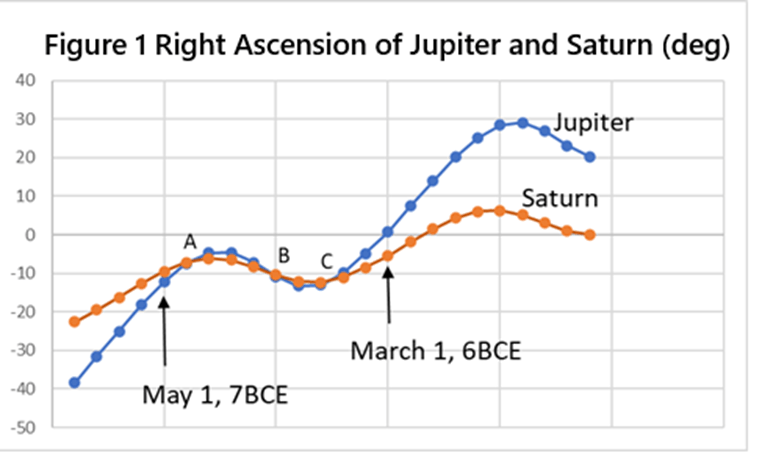
in the RA of Jupiter and Saturn six or seven years before the Christian Era (BCE=Before Christian Era). The red RA curve of Saturn intersects the blue RA curve of Jupiter at points A, B, and C, indicating that there are three conjunctions, which occur around June 1, October 1, and December 3. It can also be seen from the figure that when these three conjunctions occurred, the two planets experienced the phenomenon of “retrograde”, that is, their RA did not continue to increase, but after reaching the peak, it paused for about a month, and then began to decrease (that is, “retrograde”). After a few months, it reached the lowest point and paused for about a month, and then resumed normal forward motion. At this time, the RA of the two stars also began to separate. We generally know that Jupiter takes about 12 years to orbit the sun, and Saturn takes 29.5 years, so Jupiter and Saturn will meet once every 20 years. The “King Star” seen by the three “wise men” should be the conjunction of Jupiter and Saturn at point A (around June 1, 7BCE). At that time, the two stars were still moving forward. Not long after, in July and August, the two stars reached the apex and stopped moving. This corresponds to the star “stopped over” mentioned in Matthew 2:9. Jesus may have been born for several months at this time. (The traditional Christmas day on December 25 was set by the Roman Empire in the fourth century. Most scholars believe that it is historically inaccurate to represent the birth date of Jesus.)
Figure 2 is the sky map of Jerusalem at 3 am on June 1, 7 BC, drawn by the author using the recently developed Sky Map app (link for the App: https://SkyMapPlus.andrewl.in ). The inner circle represents the 360 degree horizons of Jerusalem. The stars inside the circle include Saturn and Jupiter in the east and Mars in the west; Mars is about to set on the horizon. The stars outside the inner circle, including the
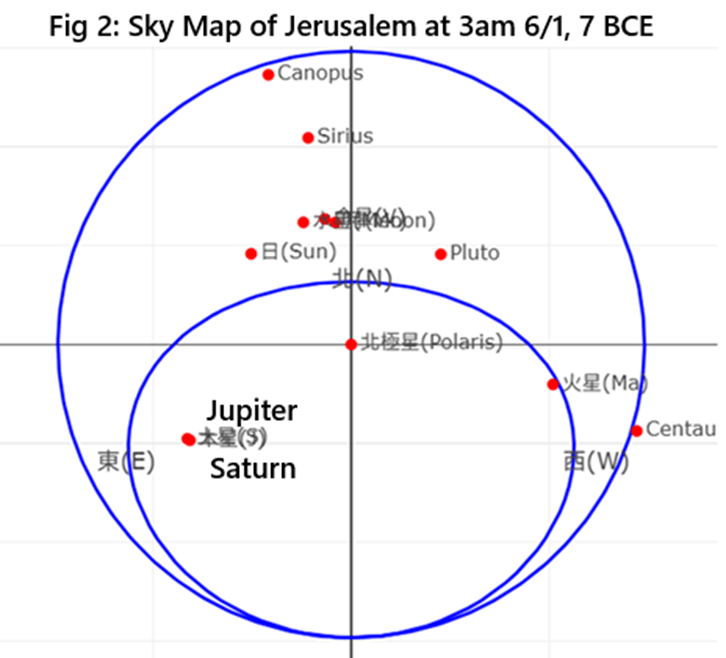
sun, Venus, Mercury and the moon etc, are all below the horizon, so the people of Jerusalem could not see them at that time (3 am). This sky map should be the sky map seen by the three wise men from the East when they were looking for Jesus at that time. As shown in the sky map, Jupiter and Saturn are highly overlaped (conjunction).
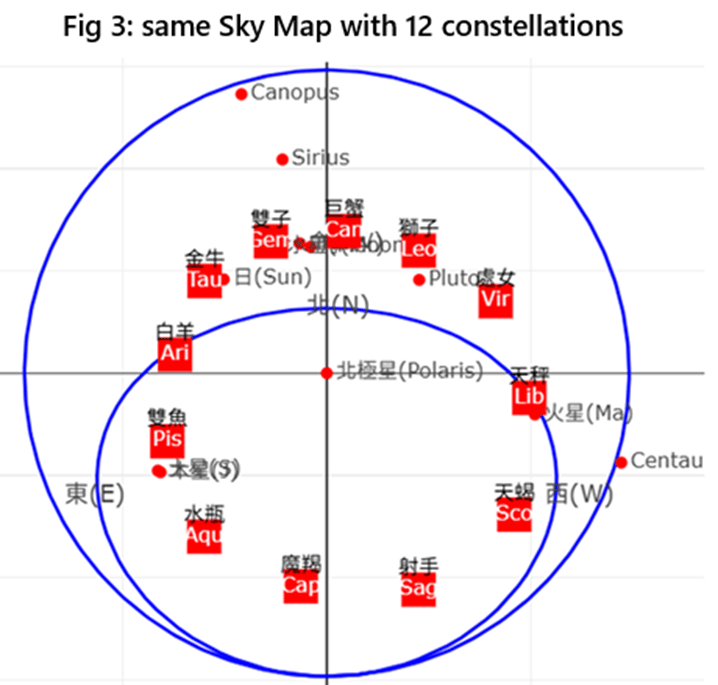
Figure 3 is the same sky map except with 12 constellations added. From the figure, we can see that Jupiter and Saturn were located in the Pisces constellation at that time.
The reign of King Herod: The question is when was King Herod still in power? The most authoritative explanation comes from Flavius Josephus. He was born in 37 AD in Jerusalem, which was then part of the Roman province of Judea. He was a Roman Jewish historian and military leader. He is famous for his two books, Antiquities of the Jews and The Jewish Wars. In his books, he said that King Herod died after a “lunar eclipse” but before the Passover of that year. In addition, the chronicles of the Roman Empire mentioned that the Roman Senate appointed King Herod as King of Judea in 40 BC. Josephus said that King Herod ruled for 37 years. The author verified the calculation of the lunar eclipse and the calculation of the Hebrew calendar for date of Passover. There was indeed a lunar eclipse visible from Jerusalem on March 13, 4 BCE, and the Passover of that year was on April 11, 4 BCE. Therefore, the time of King Herod’s death is generally believed to be between late March and early April, 4 BCE. If Herod waited for two years, and found that the three wise men all ran away because they were told in a dream not to see Herod again (Matthew 2:12) and did not come back to report to him whether they had found Jesus, then, in anger, he may have issued an order to kill all children under two years old in Bethlehem (Matthew 2:16) in 5 BCE when he was still alive. Such a timeline for Herod’s final years seems reasonable.
Conclusion: The Star of Bethlehem seen by the three wise men is the King’s Star, which should be the conjunction of Jupiter and Saturn. According to astronomical calculations, it should have occurred in early June of 7 BC. After that, the right ascension of the two stars reached the highest point, and after a period of pause, they began to retrograde. The pause before regrade is consistent with the description of the star pause in Matthew 2. The calculation of the time of the lunar eclipse in the last few years of Herod and the date of Passover indicates that he died around the end of March or the beginning of April in 4 BC. Based on the comprehensive inference of this article, Jesus should have been born in the end of May or the beginning of June in 7 BC.

 Astronodome
Leave a comment