Weather is a phenomenon that changes every day, including wind and rain, spring and autumn, which seems to be a common phenomenon known to everybody. The world is just like this, and there is no need to make a fuss, until someone says that the concentration of carbon dioxide will become higher and higher, and the Earth will become hotter and hotter. Since the industrial revolution, in order to survive and develop, humans have set up factories everywhere, burned coal and cut trees, and produced too much carbon dioxide, for which the Earth cannot bear. The temperature will get higher and higher, and finally the frog will be boiled in warm water. Humanity will be forced to have nowhere to escape by the high temperature, and even become extinct. Once this was said, it was a wake-up call to everyone. Since 1995, countries around the world have been eager to collectively select a city (Berlin, Kyoto, Montreal, Paris, etc.) every year, sent representatives to gather together for meetings, and quickly came up with ways to countermeasures and hopefully prevent any potential disaster in the future.
The Earth’s climate, a big topic of our planet, is closely related to astronomy. Our Earth is ranked third in the solar system, with Mercury and Venus in front, Mars, Jupiter, Saturn, and Uranus and Neptune behind us. But strangely, the current situation is that the first two are extremely hot, and the last five are extremely cold. Only the Earth is blessed with a suitable temperature, and in addition to water, it also has an atmosphere. I dare not say whether the Earth had such a comfortable environment 3-4 billion years ago, but it has been like this since Homo Sapiens appeared on the Earth 200,000-300,000 years ago. Of course, we hope that the Earth will always be like this, but when our Sun reaches old age (4-5 billion years from now), it will explode one day and swallow up the Earth. However, no one can control what will happen billions of years later. What we care about is that we cannot arbitrarily ruin the Earth and leave a bad and difficult environment for our descendants to survive.
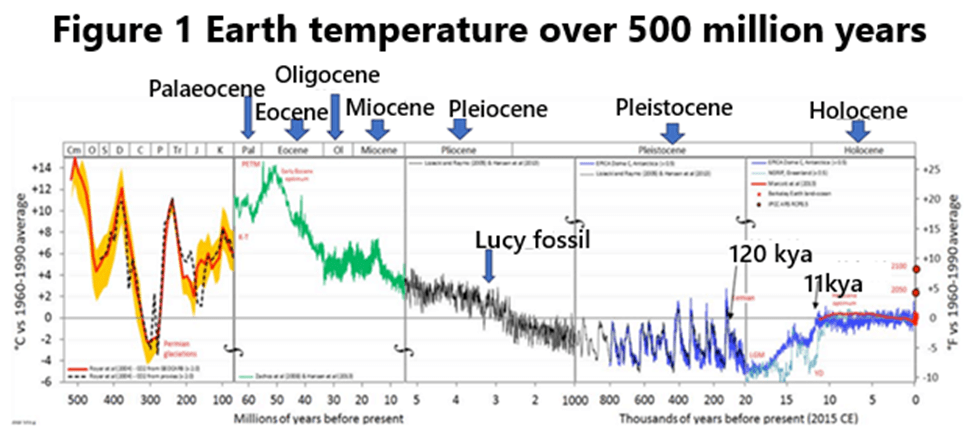
Ancient Climate Changes – Since its birth 4.5 billion years ago, the Earth has gone through a series of considerable changes. Initially, as the Earth was formed, it attracted small rocks scattered in its orbit; the huge heat generated by the collision of these rocks made the Earth like a ball of molten lava. The surface temperature is estimated to be as high as 1,982 oC. This hot ball of fire was in the extremely cold universe, so it had to cool down. Then, volcanic eruptions began to form an atmosphere, which mainly consisted of carbon dioxide and water vapor (some water may have come from asteroids bombarding the Earth in earlier time). As the surface cooled further, the water vapor condensed into water, and this formed oceans and rivers. Figure 1 shows the temperature changes of the Earth over the past 500 million years. For most of the time between 500 million and 3 million years ago, Earth’s temperature was higher than it is now.
Each gas in the atmosphere has its own cycle to create a state of balance. If there is a slight abnormality somewhere in the cycle, nature will adjust the imbalance and reach rebalance. For example, there was no oxygen in the early Earth’s atmosphere. Later, life appeared on Earth. These lives (plants and other organisms) used sunlight to produce photosynthesis. In the process of water and carbon dioxide producing energy, oxygen was released. The concentration of oxygen in the atmosphere has been imbalanced and rebalanced for more than 2 billion years, and has slowly increased to the current 20% level. As for carbon dioxide, it has its own cycle to create a balance in each geological era. Figure 2 shows the carbon dioxide concentration in the past 800,000 years after the Antarctic ice column 3 kilometers
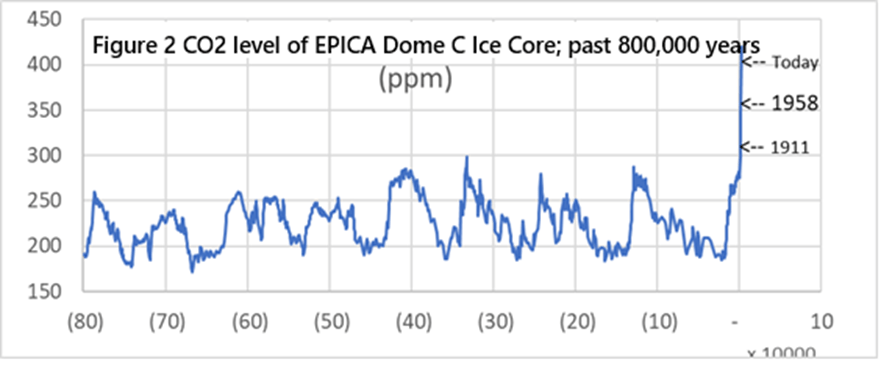
underground was dug out and analyzed. After analysis, it shows that although the concentration has fluctuated, it has always been below 300 ppm. The shocking excess occurred only after the 20th century. Today, the carbon dioxide concentration has reached 420 ppm. Could it be that human beings have been frantically pursuing civilization and progress for more than a hundred years, burning coal and cutting trees, and destroying the ecology, pushing the carbon dioxide concentration to a crazy level in a short period of time? For such a high level of carbon dioxide, how will today’s Earth respond in terms of temperature change? More specifically, how closely has the concentration of carbon dioxide been related to the Earth’s temperature since ancient times? Figure 3 shows the close relationship between the two over the past 800,000 years (the red line is temperature; the blue line is carbon dioxide concentration). Seeing this graph, many people would inevitably draw a causal conclusion: it is because of the change in carbon dioxide that the Earth’s temperature changes.
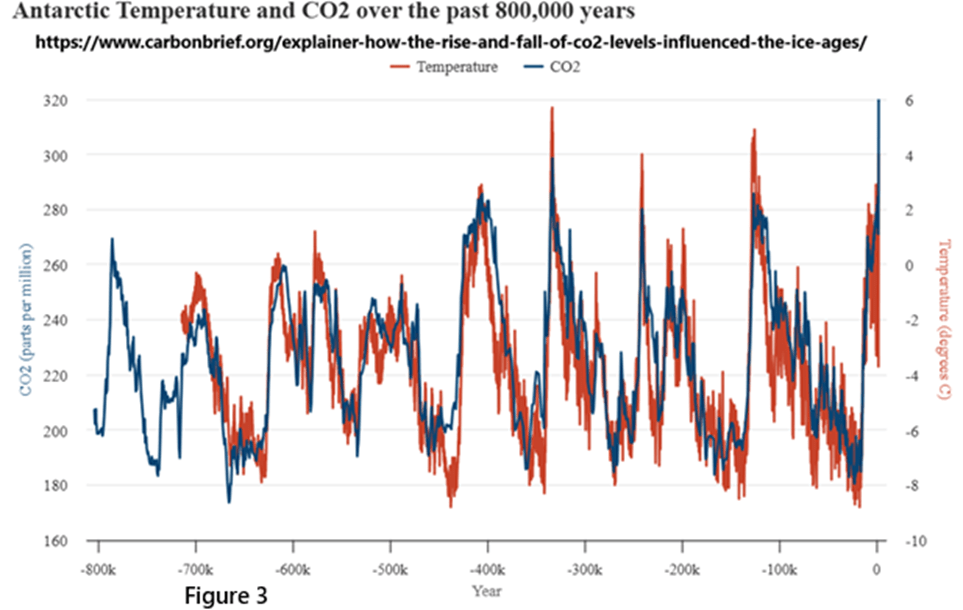
But strictly speaking, although there is a considerable degree of correlation between the fluctuations of the red line and the blue line in Figure 3, correlation does not necessarily mean a causal relationship. For example, many people will have wrinkled skin and gray hair when they get old. This correlation of wrinkling and graying cannot be inferred that the wrinkling of the skin leads to gray hair. No one would believe it. Moreover, if the change in carbon dioxide concentration is the cause and the change in Earth temperature is the effect, then the nearly 3-fold increase in concentration from 100 ppm to 280 ppm, shown in Figure 3, should produce a 10 oC change in Earth temperature, which is inconsistent with the radiation heat transfer theory discussed later in this article. Furthermore, it is not right to say that the Earth’s temperature changes synchronously with carbon dioxide. Some scholars have studied the changes in Earth temperature and carbon dioxide from 9,000 to 19,000 years ago, as shown in Figure 4. 13,000-14,000 years ago, CO2 did not change, but the Earth’s temperature first rose and then fell. 9,000 to 11,000 years ago, CO2 fell

slightly, but the Earth’s temperature continued to rise. Therefore, the Earth’s temperature has not changed in lock step with the changes in carbon dioxide. This means that there are many factors that cause climate change, not just carbon dioxide. And carbon dioxide does not seem to be the dominant factor either. In fact, the Earth has experienced many ice ages in the past 800,000 years. Serbian scientist Milutin Milankovitch began to study, in 1911, the causes of the ice ages that have occurred on the Earth in the past 800,000 years. He was convinced that the change in the position of the Earth relative to the Sun would drive the long-term climate and trigger the Ice Age. He carefully studied the Earth’s orbit itself, the rotation of the Earth’s axis and how the angle of the axis was affected by the gravitational forces of the Sun, Moon, and planets. He found that 1) the Earth’s orbit changes from less elliptical to more elliptical with a periodicity of about 100,000 years, 2) the angle between the Earth’s axis and the vertical line of the Earth’s orbit changes from 22 degrees to 24.5 degrees with a periodicity of about 41,000 years, and 3) the precession of the Earth’s axis (swinging like a spinning top) takes about 22,000 years to complete a 360-degree circle. These three cycles are well known and are now called the “Milankovitch Cycles”. Due to these three cyclical changes of the Earth itself, the direct refraction angle of sunlight on the Earth will change at a slow pace of tens of thousands of years, resulting in different insolation energy received by the Earth in each period. Too little insolation energy will trigger the occurrence of an Ice Age (Figure 5). Milankovitch’s theory holds that the amount of sunlight received by the Earth is the cause, and the resulting change in the Earth’s temperature is the effect. Qualitatively, his theory is accepted
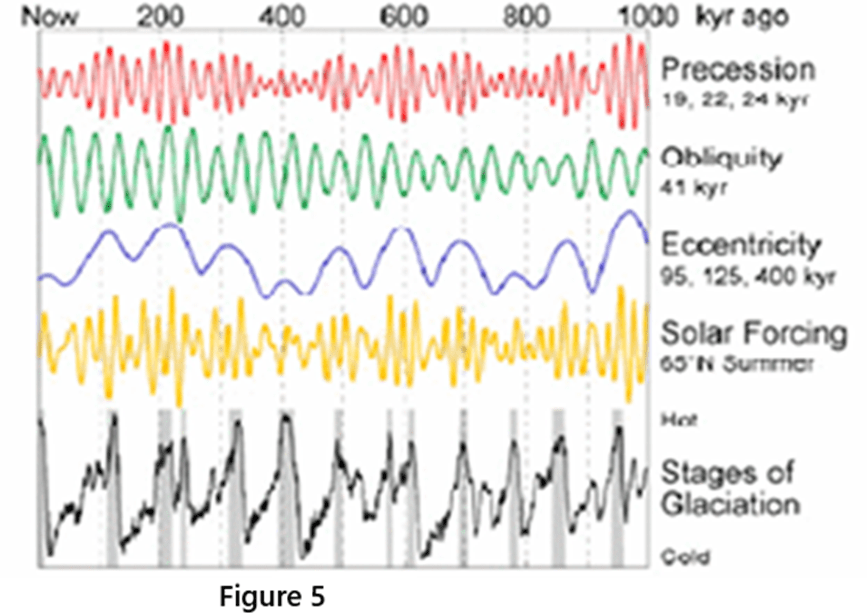
by world-wide, but quantitatively, we still must start from the basics of radiation heat transfer in physics to study how the Earth’s atmosphere handles the incoming solar energy and the dissipation of Earth’s heat energy into outer space. The basic concept will be explained later, but in simple terms, when the incoming energy is balanced with the dissipated energy, this balance determines the temperature of the Earth.
Radiative heat transfer in the atmosphere – Radiative heat transfer in the atmosphere is a complex process. Figure 6 shows the physical model of the solar energy incident on the Earth and the Earth’s heat energy dissipated into outer space. Both light energy and heat energy
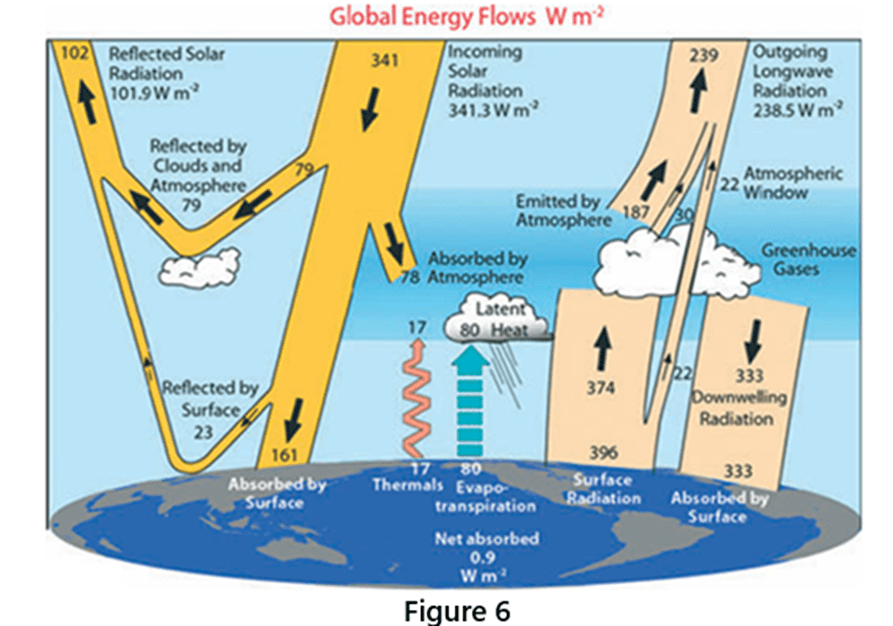
are radiation waves, the former is short wave, and the latter is long wave. Gases that absorb heat energy are called Greenhouse Gas (GHG). The most abundant gases in the atmosphere are nitrogen (78%) and oxygen (21%), but neither is GHG. Carbon dioxide and water vapor are the most important GHGs. In 1896, Swedish scientist Arrhenius began to study the impact of atmospheric GHG on the Earth’s greenhouse and published a paper saying that if the concentration of carbon dioxide doubled, the Earth’s temperature would increase by 5-6oC (a lot of over-estimation). However, the precise measurement of the Earth’s carbon dioxide concentration began in 1958 when Charles Keeling set up a measuring station on the island of Hawaii, far away from continental blocks. His measurements showed that the CO2 concentration was indeed rising year by year, providing concrete evidence for the increasingly serious global warming trend. More scientists are investing in the study of climate change. To promote the understanding of the seriousness of climate change that is threatening human survival, the scientific community, under the sponsorship of the United Nations, established the “Inter-governmental Panel on Climate Change” (IPCC) in 1988 to provide knowledge in this area to all walks of life. In 2007, former Vice President A Gore published a book “An Inconvenient Truth” to call out the global energy conservation and foster the carbon reduction movement. For this, Gore and IPCC jointly won the 2007 Nobel Peace Prize. After 14 years, S. Manabe and K. Hasselmann also won the Nobel Prize in Physics (2021) for “building a physical model of the Earth’s climate, quantifying changes and predicting global warming.” In fact, the basic concept of predicting global warming is no different from the concept of income and expenditure of our general household. Simply put, the income of the Earth (including the atmosphere) is the incoming solar energy, and its expenditure is the heat energy dissipated to outer space. When these two are in balance, the temperature of the Earth is determined. How much solar energy reaches the Earth? The surface temperature of the sun is 5500 oC. Following the theory of the blackbody radiation, and knowledge on the radius of the sun, and the distance between the sun and the Earth, one can calculate the solar energy that hits the Earth to be 1364 watts per square meter. Because the sun shines on the Earth in parallel sun rays, it is captured by the Earth’s circular area and then distributed to the entire spherical area of the Earth, so the incident solar energy outside the atmosphere is 341 watts per square meter (Figure 6). Of this, 102 watts are reflected back into outer space, and only 239 watts enter the atmosphere and reach the surface.
In order to achieve balance, the Earth and the atmosphere need to release 239 watts of heat energy to outer space. To reach outer space, the heat energy on the surface of the Earth needs to pass through the test of GHG (water vapor, CO2, ozone, etc.) in the atmosphere. These GHG gases can absorb heat energy only in certain bands, and the absorption intensity is also different. The author uses an atmospheric model, including the change of temperature and gas density with altitude, to calculate the absorption of three GHGs (water vapor, CO2, ozone), and the results are shown in Figure 7. The red curve represents the heat energy of the Earth’s surface temperature of 16 oC, which begins to dissipate heat to the atmosphere. The total heat energy of all
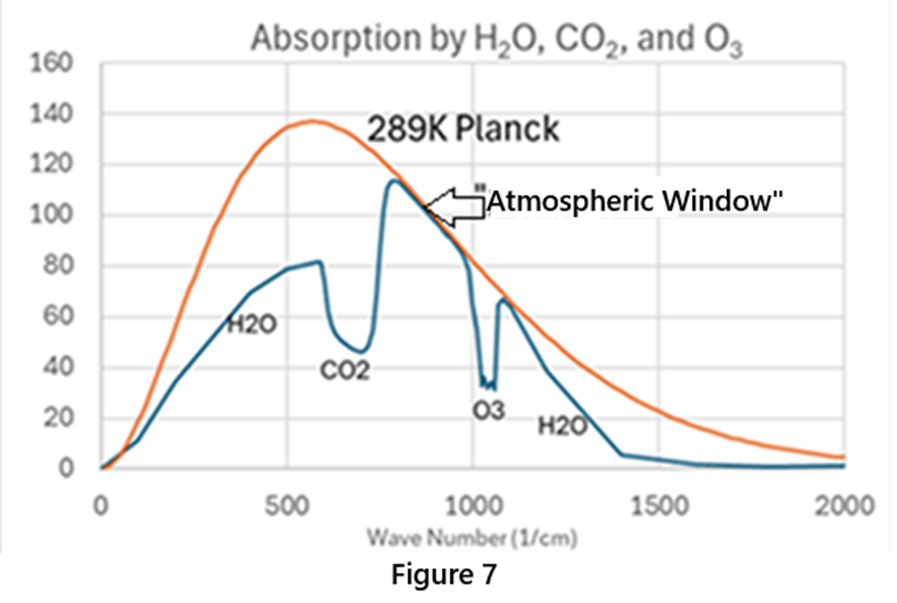
wavelengths combined is 396 watts per square meter (Figure 6). Due to the absorption of these three gases, the heat energy in some bands is not 100% transmitted. The blue curve is the last one to be transmitted, with a total heat energy of 242 watts per square meter. If the absorption of other GHGs is added, the total heat energy transmitted will become 239 watts per square meter (Figure 6). In summary, Of the 396 watts of heat energy emitted by the Earth’s surface, only 239 watts reach outer space, i.e., about 60% pass through. Now if the concentration of CO2 in the atmosphere doubles (400 ppm to 800 ppm), the greenhouse effect will increase. Using the above method, the total heat energy that passes through will drop to 235 watts per square meter. This is 4 watts less than the 239 watts that the Earth received from the Sun. This imbalance is also called “radiative forcing”. The same amount of heat is coming in, but less heat is going out, and the Earth’s temperature has no choice but to increase until the outgoing heat reaches 239 watts again, and the balance is restored and the the radiative forcing again becomes zero. Using the above method, adding the effects of “water vapor feedback” and “cloud feedback”, the amount of the Earth’s temperature needs to increase by about 2oC to re-balance. The current concentration of CO2 in the atmosphere increases by an average of about 2 ppm per year, so if the concentration is to double, it will take 200 years at the current rate. But if humans don’t control it well, the concentration increases at a faster rate, and it may double in a shorter time. The 2016 Paris Agreement has a long-term temperature goal, which is to control the rise in global surface temperature to well below 2°C above pre-industrial levels. The treaty also stipulates that it is best to limit the temperature rise to 1.5°C. This agreement was signed by most member states of the United Nations, and its purpose is to gather the power of all mankind to make long-term joint efforts to control carbon dioxide emissions to slow down global warming. The collective activities of “energy conservation and carbon reduction” that we are familiar with include promoting electric vehicles that do not burn gasoline, promoting rooftop solar panels, and promoting various “green energy” policies such as offshore wind power generation. Humans are doing their best to reduce carbon dioxide emissions. After all, compared with the ultra-slow speed of global temperature changes in the past (as shown in Figure 5, the difference in global temperature between the coming and going of the ice age can reach 12°C, but this takes a very long time of 100,000 years to achieve. That is, the average difference in temperature in 100 years is only 0.012°C), The extremely fast pace of global warming since the Industrial Revolution has indeed made humans tremble with fear, and they dare not slack off. However, to scare people by saying that “human beings will be frogs in warm water” is an exaggeration and lacks persuasiveness.
Conclusion: The major event that all humanity has to work together and prevent from happening was in the 1950s and 1960s when there was nuclear arms race; it was the fear of the instant destruction of humanity. In contrast, the destruction of humanity by climate change does not occur in an instant, it is over a prolonged period of time and has a wider impact on people’s lives. Indeed, the destructive power of the former is instantaneous and huge, and its scientific basis is also believed with no doubt by everyone. The destructive power of the latter is negligible in a short period of time. Therefore, many people are still not fully convinced if they are given only the fact that the model calculations are consistent with the data obtained by outer space instruments†. They would not accept that consistency can prove that scholars and experts have 100% grasp of all the causes of climate change. Consequently, there exists uneven implementation of the Paris Agreement by various countries. Some countries even withdrew from the Agreement. So, while we must respect the data measured by instruments, such as “CO2 concentration has gradually increased from 320 ppm in 1960 to 420 ppm in 2025″, or “the average temperature of the Earth has risen by 1.5oC compared to the industrial revolution era”, we should be careful when hearing someone saying that “the recent rapid rise in CO2 is all caused by humans”. This is because the increase in CO2 can come from many places. For example, if the global average temperature rises due to some factors unrelated to humans, the ocean temperature will also rise. When the water temperature rises, the ability to contain CO2 decreases (just like when a Coca-Cola bottle is heated, there will be more bubbles), and the ocean will spit out CO2 into the atmosphere. Moreover, it is obviously wrong to say that “CO2 is solely responsible for the high global average temperature”. Therefore, we should be very careful not to over-trust the model calculations and not to jump to its conclusion. Therefore, the extremely complex causes of climate change require more in-depth academic research (including the influence of clouds, ocean currents and crustal separation and combination, etc.) as well as data collection, analysis and repeated verification from all aspects, in order to develop a complete argument to explain not only the various details of the current but also the various changes in the Earth’s temperature over the past hundreds of thousands of years, quantitatively, so that all mankind and all countries can be convinced without a doubt and formulate policies to prescribe the right remedy. After all, we all sincerely hope to protect the Earth for our descendants. If CO2 is truly the primary culprit for global warming, we should all work together to save Earth from the fate of our next-door neighbors, Mars and Venus.
† A famous example of the agreement between model calculation and observation is Ptolemy’s “geocentric theory” in the second century AD, which used the “deferent” and “epicycle” models to calculate the movement of various celestial bodies, and the results were completely consistent with the astronomical observations at the time, including the moons of Jupiter. This “geocentric theory” dominated human cognition of the universe for more than a thousand years, until Newton proposed the “law of gravity”, which proved that the “geocentric theory” was wrong.

 Astronodome
Leave a comment